
You cannot send your degree to HEC through TCS any more. HEC has introduced a fully online, paperless Degree Attestation System that replaced the previous process, removing the need for applicants to visit HEC offices or submit original documents in hard copy. The upgraded system became effective from 11 May 2026.
That ends the arrangement most guides still describe. Under the old system, HEC had officially designated TCS to handle domestic attestation seekers, with applicants handing over the application form, educational documents and courier charges at TCS centres. You paid the fee through 1-Link, downloaded the application form, took your originals to a TCS counter, uploaded the courier receipt into your HEC account, and waited for the sealed envelope to come back. None of that applies to a new application today.
What you do instead: apply at eservices.hec.gov.pk, upload scans, pay Rs 3,000 per document, and download an e-Attestation Certificate when it is issued. No originals leave your hands.
Courier tracking has not stopped mattering, though. It has just moved down the chain, to MOFA and IBCC, where documents still travel physically. That part is covered further down.
What the old courier route was, and why it ended
The courier mode existed because HEC only had counters in Islamabad, Lahore, Karachi, Peshawar and Quetta. A graduate in Bahawalpur or Chitral either travelled, sent someone with an authority letter, or used the designated courier. TCS was responsible for returning the submitted documents to applicants at their given addresses, at published region-wise rates, which ran between roughly Rs 90 and Rs 140 depending on district. Those rates were set in March 2022 and are historical now.
HEC announced in December 2025 that it had started a project to rebuild the attestation system using blockchain technology, expected to finish within six months, while the National Assembly Standing Committee on Government Assurances had separately pressed HEC to cut attestation turnaround time. The replacement launched on schedule in May.
Two practical consequences. First, your original degree never goes into a courier bag, so the risk of loss in transit is gone. Second, the fee rose from Rs 1,000 to Rs 3,000 per document, and HEC’s chairman said a portion of the collected fee goes to universities to support document verification.
If your degree was attested before May 2026, the old stamp stays valid. Nothing needs redoing.
How HEC degree attestation works now
HEC states the system runs in four steps: submission of the online application by the applicant, scrutiny of the application by HEC, verification of academic documents by the respective university or HEI, and issuance of the e-Attestation Certificate by HEC.
Only the first step is yours. The other three are why applications sit.
- Create or sign into your account at eservices.hec.gov.pk. Use your CNIC without dashes. Existing eportal users keep the same credentials.
- Complete your profile. Personal details must match your CNIC exactly, and academic history is entered from Matric onward. A spelling difference in a father’s name is enough to stall a case.
- Select the documents to attest. Attestable types are the degree, the transcript (result card, result intimation card or detailed marks certificate), a provisional certificate issued by the university’s examination office, and an HEC equivalence letter.
- Upload clear scans of your CNIC and each document. Dark, cropped or blurry files come back as revision requests.
- Pay. Clicking Proceed for Payment generates a Consumer Number, paid through any online banking channel, after which you must click Verify Payment in your account. Paying the bill is not the same as submitting. Until the payment is verified, the application sits in pending mode.
- Wait through scrutiny and university verification, then download the certificate. Applicants are notified by SMS and email when the e-Attestation Certificate is issued, and can download it from their online account.
Fee and what it covers
The attestation fee is Rs 3,000 per document, covering a degree, transcript, provisional certificate or HEC equivalence letter. HEC warns that an incorrectly selected document is neither refunded, adjusted nor transferred. Check the selection twice before paying. Two documents means Rs 6,000, not Rs 3,000 for the pair.
Attestation of photocopies is no longer offered. That removes the old Rs 700 photocopy line entirely, and with it the rule that photocopies could only be attested after the originals.
How long it takes
HEC does not publish a guaranteed turnaround for the new system, and no honest guide can give you a fixed number. The variable is your university. Step three depends on how quickly your HEI responds to the verification request, and that varies widely between institutions. Reports after the May rollout also flagged routing and certificate-generation glitches during the transition.
Plan on weeks, not days, and start before you have a deadline rather than after.
Where courier tracking still matters
HEC attestation is usually step one. For most jobs and visas abroad, the chain runs HEC or IBCC first, then the Ministry of Foreign Affairs, then in some cases an embassy. Those later steps still move paper.
MOFA processes documents through authorised courier companies, including Gerry’s International, Leopards, M&P Express Logistics and TCS, so applicants do not have to travel to Islamabad, Lahore, Karachi, Peshawar, Quetta or Gujrat in person. The courier collects the documents, submits them to MOFA, and returns them once attested, charging its own service fee on top of the government fee. IBCC attestation for Matric and Intermediate certificates also runs a courier option.
So the scenario that sends people looking for “HEC documents courier tracking” still happens. It just happens one stage later, with a MOFA or IBCC file rather than an HEC one.
Track your courier shipment
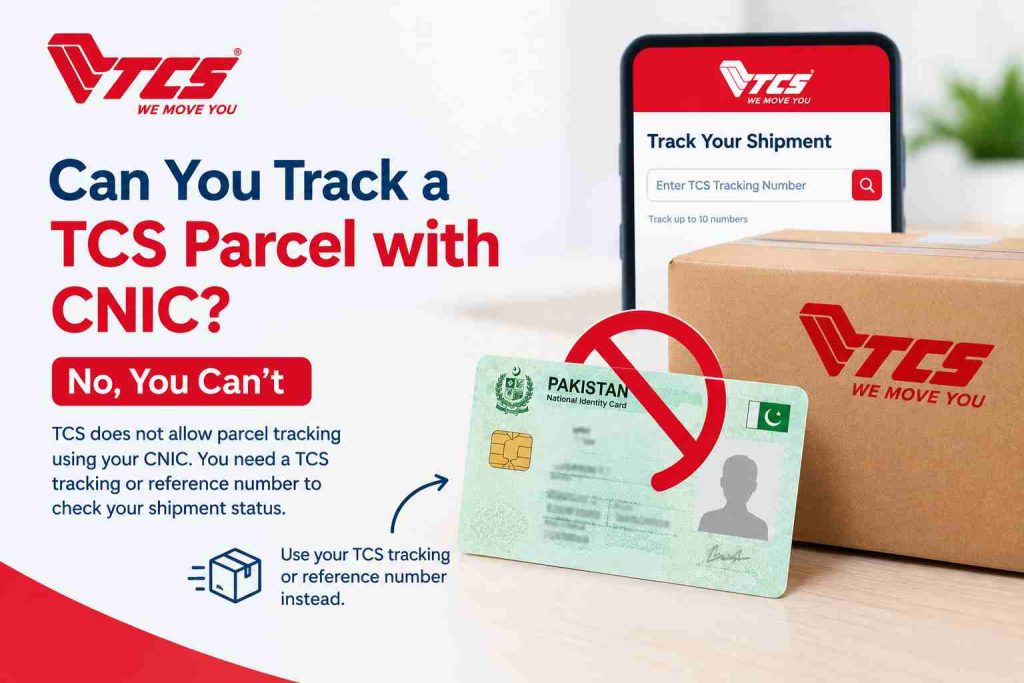
If you have handed documents to TCS for MOFA, IBCC or an embassy submission, the receipt carries a consignment number. Enter it into the TCS tracking tool to see the current status and the location of the last scan. It is free and needs no login.
One boundary worth being clear about. A consignment number tracks a physical shipment through the TCS network and nothing else. It does not show the status of a government attestation application. HEC application status lives in your account at eservices.hec.gov.pk. MOFA and IBCC statuses live in their own portals. Two separate things, two separate places to look.
Courier receipt, tracking number, application number
Three identifiers get confused constantly:
| Identifier | Issued by | What it tracks |
|---|---|---|
| HEC application ID | HEC portal | Your attestation case, visible in your HEC account |
| Consignment number (CN) | TCS at booking | The physical movement of a parcel or envelope |
| Courier receipt | TCS counter | Proof you handed over the documents, and where the CN is printed |
A TCS consignment number is a numeric code, typically ten to thirteen digits, sometimes printed with a “CN” prefix. Length varies by service type, booking channel and origin branch, so counting digits is not a reliable way to check whether a number is valid. Compare it character by character against the slip instead. If you are unsure what you are looking at, where the consignment number is printed walks through the receipt layout.
Keep the receipt until the documents are back in your hands. It is the only proof of handover, and the helpline will ask for the CN before anything else.
If the number does not track
Give it until the end of the next business day. A shipment is not visible until it has been scanned into the network, and a late-afternoon booking often shows nothing until the following morning. After that, check the characters, strip spaces, and confirm the courier. Six specific causes and their fixes are covered in tracking number is not working.
A different problem is a number that tracks but sits still. Scans happen at facilities, not on the road, so a quiet stretch on an intercity shipment is normal rather than a sign of trouble. Status has not moved for days explains when waiting is right and when to call. For anything TCS has to resolve, contact TCS directly, and the nearest TCS Express Centre map covers walk-in queries.
Problems people run into
Application stuck at university verification. This is the most common complaint under the new system, and it is not on your side. Contact your university’s registrar or examination office and ask whether they have received the HEC verification request. Universities with incomplete digital records are slower.
CNIC and degree details do not match. A name spelled differently, a father’s name with an initial, a date of birth that differs by a digit. Get the record corrected at the source before applying, not after.
University or programme not recognised. HEC will not attest a degree from an institution or programme it does not recognise. Check the recognised list before paying.
Paid but the application is not submitted. You skipped Verify Payment. Log in and complete it.
Wrong document selected at payment. HEC states the fee will not be refunded, adjusted or transferred. Nothing to do but pay again for the right one, which is why the selection screen deserves a slow read.
For portal problems, HEC directs queries to onlinehelp.hec.gov.pk or UAN 111-119-432.
FAQs
Can I still get my HEC degree attested through courier?
No. HEC’s online paperless system replaced the previous process, and applicants no longer submit original documents in hard copy. Applications go through eservices.hec.gov.pk only.
Is TCS still the designated courier for HEC attestation?
Not for degree attestation. TCS held that designation under the old system. With originals no longer being submitted, there is nothing for a courier to carry on the HEC leg.
What does HEC attestation cost in 2026?
Rs 3,000 per document, paid online through a generated Consumer Number.
What do I get instead of a stamp?
A verifiable e-Attestation Certificate, downloadable from your HEC portal account, which institutions can check online.
Is my old HEC stamp still valid?
Yes. Attestations issued before the switch remain valid and verifiable.
Do I still need a courier anywhere in the process?
Often yes, for MOFA and IBCC. MOFA works through authorised courier companies including TCS, which collect documents, submit them, and return them attested.
How do I track documents I sent through TCS?
Enter the consignment number from your receipt into a TCS tracking tool. It shows shipment scans, not government application status.
Where is the consignment number printed?
On the receipt slip from the Express Centre, near the barcode, and in the dispatch SMS if one was sent.
Is TCS tracking the same as attestation status?
No. TCS tracking shows where a parcel is. HEC, MOFA and IBCC each show application status in their own portals.
How long does the new HEC process take?
HEC does not commit to a published timeline. The pace depends largely on your university’s response to the verification request. Apply well ahead of any deadline.
Can overseas applicants use the new system?
Yes. The process is online, which removes the older split between domestic courier and international courier arrangements.
Can HEC attest photocopies?
No. Attestation of photocopies is no longer offered.